I know it's a cliché, but the possibilities are endless with today's technology. I put together this video to promote myself, give some examples of how I train my clients and show what I believe in when it comes to personal training; EDUCATION, MOTIVATION & INSPIRATION.
All feedback is welcome, I hope you find this video inspiring and seductive!=)
/Speilberg
Ps. Any good advice to avoid blisters? I ran 12 miles yesterday in preparation for my Stockholm Marathon coming up 2 weeks from now (!), my feet are not liking it today...
May 23, 2010


May 19, 2010
AN EYE-OPENING ARTICLE

Yesterday, my routinely USA Today's "Life"-section check hit jackpot. Every now and then they publish health and fitness articles on interesting topics. Here you'll find the link to the article (or take a peak at the picture above), hopefully opening up eyes to people across US about the often neglected (forgotten?) importance of running technique (in this case Chi Running) (see all my previous posts POSE METHOD of Running, etc, etc).
On the other hand, I don't think the content of the article is very good, after all. And as always, with brief information given (e.g. "land on your forefoot") there's a great risk that the reader leaves out crucial iformation, like the old saying goes: "a little knowledge is dangerous".
I also found it ridicilous how the Pose Method of Running first of all is hardly mentioned in the article, second is being bad mouthed as "a technique invented by the Russians in the 80's" which makes it sound like some form of dirty, cold-war strategy developed so that the Soviet union could take over the world (when in fact it is the mother of running methods that was developed by a sports scientists named Nicholoas Romanov who just happened to be born in Russia and taught at University of Moscow back in the 70's. Dr.Romanov has then been living in USA since the 80's - coaching Olympic athletes and triatheles all over the world).
Now, one might wonder what the difference is between Chi Running and the Pose Method? I'll try to give my view of that question in a near future.
/Henrik
May 18, 2010
STOCKHOLM MARATHON

Stockholm Marathon - 42.195 meters - or 138.435 feet.
I've always wanted to run a Marathon and last week I was convinced to grab the bull by its horns, so to speak. Seems like I'll be hitting the streets of Stockholm on June 5th, together with 20.000 other runners, during my short visit to Sweden in a few weeks.

The course: Two almost-identical loops, starting outside the 1912 Olympic Stadium and finishing on the track inside. There are large, flat sections of the course but enough undulations, particularly on the loop around Djurgarden and the various bridges, to break your rhythm.
Highs: Finishing on the track inside the 1912 Olympic Stadium.
Lows: Passing the kilometre markers on the first lap, knowing you have to run 21km before you see them again.
Watch out for: The crossing of the Vesterbron at 35km. The bridge is only a 90ft climb, but it feels worse the second time around.
Yeah, I know, running a Marathon is not a casual, spontaneous run for the weekend warrior averageing running volumes of 3-4 miles per week (not speaking about myself here=)) and it's nothing one should do without proper preparation...ever...Anyway, I'm doing this knowing I might not be a top 3-contender, meaning I will do my best to enjoy the atmosphere and fun of the event (and the experince, of course!). I figure I can get a few long distance runs to prepare myself even though I have less than 3 weeks until I'll be standing on the starting line, June 5th, 2010. But hey, what better way to celebrate my 25th birthday than an "organized sightseeing tour of Stockholm on foot" (as a friend of mine nicely resembled the race)?
This will be interesting...stay posted!
/Haile
May 11, 2010
WHY VIBRAM'S?
One day into my Vibram ownership and I've already gotten looks and questions from people literally saying "What on earth are you wearing?" (in the mildest forms). So with this post I will from now on just refer all wonderers to my blog instead of giving that five minute explanation...Below are some of the facts that motivated me to get a pair of VFF's in the first place...
Daniel Lieberman, a professor in Human Evolutionary Biology at Harvard University, has done a lot of research on running technique, foot-strike and the impact forces on shod running vs. barefoot running.
birthdayshoes.com has done a nice job summarizing the results of Daniel Lieberman's barefoot running research and I encourage you to read it here.
Also, books like Born to Run and POSE Method of Running(see my previous blog post "POSE METHOD OF RUNNING: review") has inspired me to get a pair and try it myself.
Shoes shape our feet probably more than we think. The "doll-feet" and x-ray image below is an extreme horror-example of foot-shaping, called foot binding, a popular custom in China until about 100 years ago...


This foot is from a barefoot population in the Philippines (taken from a study performed over 100 years ago, examining the feet of native barefoot populations). Notice that a line can be drawn that runs through the heel, ball, and big toe and that the little toes spread naturally and fan out to provide a wide, stable base for walking or standing.

The picture above demonstrates feet that are shaped like the owner’s shoes (taken from the same study, published in 1905), toes crowd to a base that's relatively unstablea and narrow for walking or standing.

Now this high-heel issue doesn't neccesarily effect me personally, but you'll get the idea; shoes can potentially result in excessive plantar flexion of the ankle (tight/weak posterior chain), shift of center of mass/gravity of the body that very well can lead to overcompensations in postural muscules and the spinal curvature (lordosis/kyphosis), etc.
Vibram's claims to:
"strengthen and stretch muscles in the feet and lower legs and stimulate neural fucntion, improving balance and agility, allow the foot to move naturally, improves range of motion in feet, ankles and toes, improves proprioception and body awareness and improving posture by lowering heel distributing bodyweight evenly".
These are some of the (at least claimed) advantages of VFF's and to add to it, they are incredibly light, machine washable and great for all kinds of water sports + strength training (e.g. they took my squatting to new dimensions yesterday)!

Now, I already established yesterday that I'm not doing missionary work for Vibram quite yet and there are some downsides to VFF's too. For example;
They draw attention to you (especially wearing coloured ones) and that might not be wanted by everyone.
They cost quite a lot of money and that's never a good thing (unless your a stockholder or the owner, of course).
Like mentioned earlier, questions like why?, what? and how much? will most likely be asked on a daily basis.
Some people might think they are excrutiating ugly (fun fact; Google "excrutiating ugly" and "A Hate Croc's"-website is the first hit...nuff said) and that might be a problem if you care what other people think, that is.
The number one downside has to be the overuse-syndrome that can take over and lead to injuries - causing a reversed effect of the desired one. Therefore, if you're considering getting a pair, a structured progession plan that allows your feet, muscles, tendons and ligaments to adapt is vital for a healthy/happy relationship between your Vibram's and feet.
Now, this post turned out longer than I thought it would be, but I hope I at least a little bit managed to motivate why I'm walking/running around these somewhat weird "shoes".
So long!
/Henrik
Daniel Lieberman, a professor in Human Evolutionary Biology at Harvard University, has done a lot of research on running technique, foot-strike and the impact forces on shod running vs. barefoot running.
birthdayshoes.com has done a nice job summarizing the results of Daniel Lieberman's barefoot running research and I encourage you to read it here.
Also, books like Born to Run and POSE Method of Running(see my previous blog post "POSE METHOD OF RUNNING: review") has inspired me to get a pair and try it myself.
Shoes shape our feet probably more than we think. The "doll-feet" and x-ray image below is an extreme horror-example of foot-shaping, called foot binding, a popular custom in China until about 100 years ago...


This foot is from a barefoot population in the Philippines (taken from a study performed over 100 years ago, examining the feet of native barefoot populations). Notice that a line can be drawn that runs through the heel, ball, and big toe and that the little toes spread naturally and fan out to provide a wide, stable base for walking or standing.

The picture above demonstrates feet that are shaped like the owner’s shoes (taken from the same study, published in 1905), toes crowd to a base that's relatively unstablea and narrow for walking or standing.

Now this high-heel issue doesn't neccesarily effect me personally, but you'll get the idea; shoes can potentially result in excessive plantar flexion of the ankle (tight/weak posterior chain), shift of center of mass/gravity of the body that very well can lead to overcompensations in postural muscules and the spinal curvature (lordosis/kyphosis), etc.
Vibram's claims to:
"strengthen and stretch muscles in the feet and lower legs and stimulate neural fucntion, improving balance and agility, allow the foot to move naturally, improves range of motion in feet, ankles and toes, improves proprioception and body awareness and improving posture by lowering heel distributing bodyweight evenly".
These are some of the (at least claimed) advantages of VFF's and to add to it, they are incredibly light, machine washable and great for all kinds of water sports + strength training (e.g. they took my squatting to new dimensions yesterday)!

Now, I already established yesterday that I'm not doing missionary work for Vibram quite yet and there are some downsides to VFF's too. For example;
They draw attention to you (especially wearing coloured ones) and that might not be wanted by everyone.
They cost quite a lot of money and that's never a good thing (unless your a stockholder or the owner, of course).
Like mentioned earlier, questions like why?, what? and how much? will most likely be asked on a daily basis.
Some people might think they are excrutiating ugly (fun fact; Google "excrutiating ugly" and "A Hate Croc's"-website is the first hit...nuff said) and that might be a problem if you care what other people think, that is.
The number one downside has to be the overuse-syndrome that can take over and lead to injuries - causing a reversed effect of the desired one. Therefore, if you're considering getting a pair, a structured progession plan that allows your feet, muscles, tendons and ligaments to adapt is vital for a healthy/happy relationship between your Vibram's and feet.
Now, this post turned out longer than I thought it would be, but I hope I at least a little bit managed to motivate why I'm walking/running around these somewhat weird "shoes".
So long!
/Henrik
May 10, 2010
MY NEW FANCY ITALIAN SHOES

Got my own pair of Vibram FiveFingers today (Italian brand although made in China...)! I haven't been this excited about new shoes since I don't know when.
Like established earlier, there is a current hype in the fitness world to train "natural", caveman-style or whatever you wanna call it. Clearly it has gotten my attention and effected me too so it will be really interesting to see how these freaky shoes will work for me (I will attempt to run with my Vibram's - but under very strict, baby-step-forms - so stay tuned on how that goes).

It remains to be seen if I will also turn in to one of those devoted "Vibram:er's" that turn heads on the streets...
Btw, this is by no means an advertising post (like I said, I still haven't really tried them yet and surely had to pay $ for my pair) but if you're considering to update your shoe-arsenal yourself, be aware of cheap copies and unofficial resellers (there's a ton of them online and I almost fell in the trap).
Expect an update on my first verdict pretty soon - until then, stay strong and keep the emails and questions coming!
/Henrik
May 7, 2010
INTERMITTENT FASTING METHODS - INTRO
After many promises to follow up my previous intermittent fasting (IF) posts, here's one that explains more about the method in general and compares some of the most popular branches of IF. Now, to leave you with a little cliffhanger, you can expect to see an even longer follow-up post on findings from IF studies and articles that will hopefully straighten out some of the questionsmarks you might have about the IF-method its advantages.
Disclaimer:
Let me begin by saying I don't recommend Intermittent Fasting (IF) to anyone without completing an individual nutrition screen and consultation. IF is not simply a nicer word for a “skipping breakfast”-diet. IF still requires planning, knowledge, timing, discipline and motivation to follow, just like any other diet with a thought behind it. So before considering IF, consult with an expert, or at least learn enough about the methods to have a clear understanding and purpose why you want to pursue it.
What is Intermittent Fasting (IF)?

I know I already briefly touched on this quetion in a previous post but I felt it needed to be developed a little further...
Intermittent Fasting, or IF as I will be referring it to in this post, is basically a cycle of eating/fasting. Liquid intake should ideally be restricted to calorie free beverages during the fast (not like Ramadan when fast=no food nor water until after sunset).
Please note that IF is not a miracle eating method that allows you to binge in Pizza and french fries during the eating window. IF is not a fool proof diet either, if a change in body composition is desired, smart, healthy food choices is still very important. In fact, if fewer calories are consumed than before, there's less room for “empty” calories, to meet adequate daily amounts of micro- and macronutrients.
"Eat no breakfast – consume 2-4 meals per day (up to 2000 kcal/meal) and finish your day by eating your last meal before you go to bed"...At first, hearing these eating advice sounds like an epic fail. And prior to my IF research, I was convinced that such eating habits was a recipe for disaster (read: weight gain). “Eat frequent meals to keep the metabolic fire going” was a mantra, and claimed by many to be the only and best way to stay lean and healthy. This article brings up some strong arguments that challenges the frequent meal pattern (and I'm no longer opposing that either).
Below follows descriptions on some of the most popular IF methods you'll find today:
THE WARRIOR DIET

A very popular method from a book (which I'm yet to read) with the same title. The method has a daily 20/4 hrs fast/feed window (although it allows for small meals during the fast, vegetables, fruits, etc). The Warrior Diet is big on natural, unprocessed foods (read my previous blog post: BACK TO BASICS WITH THE CAVEMAN TREND).
EAT STOP EAT

An IF method with 24 hrs fasting, 1-2 times per week. That means total calorie intake for a week can potentially drop by up to 30%. The Eat Stop Eat method has many success stories and I'm curious myself to investigate it further.
Alternate Day Fasting – ADF (also known as EOD, Every Other Day fasting)
An eat-one-day/fast-the-next diet. This method is said to be appealing because it lets you focus hunger in manageable periods - “instead of being a little hungry all the time, you're very hungry a little of the time”. In order not to literally fade away and balance the calorie deficit, the method suggests you consume twice the amount of calories during the feeding period. Personally, this is not very appealing to me.
LEANGAINS

Leangains (by Martin Berkhan), is what got me ultimately into IF and therefore I'm following many of the philosophies from the Leangains protocols. This IF method is relatively strict, big on calorie timing, etc for effective muscle gains/maintenance during fat loss and/or a sustainable year-long, lean physique. As you might have read in my previous blog posts, Leangains has many success stories and Martin does a great job in backing up his method with research and impressive knowledge in nutrition.
Click here to read the Leangains guide.
Click here to read a blog post that compares the Warrior Diet and Eat Stop Eat – two different IF methods.
Finally, to wrap up the whole "what is IF"-question, IF is not one of those new diet fads that seem to pop up every now and then. In fact, IF was around way before the word “kilocalorie” was even spelled out. The first homosapiens followed IF without knowing it, and had no other choice either (although I'm sure our ancestors would indulge in sugar and simple carbs if only they were given the chance). Back in the days, Fruitful hunting was followed by feasting - then followed by famine (shortage of food) until hunger started the circle again. These random food patterns is (most likely) how the human body is still meant to eat, evolution just hasn't adapted to refrigerators, preservatives and refined carbs quite yet. This is where the recent “cavemen trend” originates from – bring it back to where it all started and how humans supposedly are meant to eat and live.

Now, if you got this far reading without skipping through the text I assure you don't want to miss the next post on studies that support IF, etc. And even if you did scroll down all the way to the bottom, check back again because IF and the supporting facts behind the method is worth a second look. Guaranteed.
Cheers, have a great weekend!
/Henrik
Disclaimer:
Let me begin by saying I don't recommend Intermittent Fasting (IF) to anyone without completing an individual nutrition screen and consultation. IF is not simply a nicer word for a “skipping breakfast”-diet. IF still requires planning, knowledge, timing, discipline and motivation to follow, just like any other diet with a thought behind it. So before considering IF, consult with an expert, or at least learn enough about the methods to have a clear understanding and purpose why you want to pursue it.
What is Intermittent Fasting (IF)?

I know I already briefly touched on this quetion in a previous post but I felt it needed to be developed a little further...
Intermittent Fasting, or IF as I will be referring it to in this post, is basically a cycle of eating/fasting. Liquid intake should ideally be restricted to calorie free beverages during the fast (not like Ramadan when fast=no food nor water until after sunset).
Please note that IF is not a miracle eating method that allows you to binge in Pizza and french fries during the eating window. IF is not a fool proof diet either, if a change in body composition is desired, smart, healthy food choices is still very important. In fact, if fewer calories are consumed than before, there's less room for “empty” calories, to meet adequate daily amounts of micro- and macronutrients.
"Eat no breakfast – consume 2-4 meals per day (up to 2000 kcal/meal) and finish your day by eating your last meal before you go to bed"...At first, hearing these eating advice sounds like an epic fail. And prior to my IF research, I was convinced that such eating habits was a recipe for disaster (read: weight gain). “Eat frequent meals to keep the metabolic fire going” was a mantra, and claimed by many to be the only and best way to stay lean and healthy. This article brings up some strong arguments that challenges the frequent meal pattern (and I'm no longer opposing that either).
Below follows descriptions on some of the most popular IF methods you'll find today:
THE WARRIOR DIET

A very popular method from a book (which I'm yet to read) with the same title. The method has a daily 20/4 hrs fast/feed window (although it allows for small meals during the fast, vegetables, fruits, etc). The Warrior Diet is big on natural, unprocessed foods (read my previous blog post: BACK TO BASICS WITH THE CAVEMAN TREND).
EAT STOP EAT

An IF method with 24 hrs fasting, 1-2 times per week. That means total calorie intake for a week can potentially drop by up to 30%. The Eat Stop Eat method has many success stories and I'm curious myself to investigate it further.
Alternate Day Fasting – ADF (also known as EOD, Every Other Day fasting)
An eat-one-day/fast-the-next diet. This method is said to be appealing because it lets you focus hunger in manageable periods - “instead of being a little hungry all the time, you're very hungry a little of the time”. In order not to literally fade away and balance the calorie deficit, the method suggests you consume twice the amount of calories during the feeding period. Personally, this is not very appealing to me.
LEANGAINS

Leangains (by Martin Berkhan), is what got me ultimately into IF and therefore I'm following many of the philosophies from the Leangains protocols. This IF method is relatively strict, big on calorie timing, etc for effective muscle gains/maintenance during fat loss and/or a sustainable year-long, lean physique. As you might have read in my previous blog posts, Leangains has many success stories and Martin does a great job in backing up his method with research and impressive knowledge in nutrition.
Click here to read the Leangains guide.
Click here to read a blog post that compares the Warrior Diet and Eat Stop Eat – two different IF methods.
Finally, to wrap up the whole "what is IF"-question, IF is not one of those new diet fads that seem to pop up every now and then. In fact, IF was around way before the word “kilocalorie” was even spelled out. The first homosapiens followed IF without knowing it, and had no other choice either (although I'm sure our ancestors would indulge in sugar and simple carbs if only they were given the chance). Back in the days, Fruitful hunting was followed by feasting - then followed by famine (shortage of food) until hunger started the circle again. These random food patterns is (most likely) how the human body is still meant to eat, evolution just hasn't adapted to refrigerators, preservatives and refined carbs quite yet. This is where the recent “cavemen trend” originates from – bring it back to where it all started and how humans supposedly are meant to eat and live.

Now, if you got this far reading without skipping through the text I assure you don't want to miss the next post on studies that support IF, etc. And even if you did scroll down all the way to the bottom, check back again because IF and the supporting facts behind the method is worth a second look. Guaranteed.
Cheers, have a great weekend!
/Henrik
Apr 30, 2010
A recap of the 2010 IDEA FITNESS FUSION CONFERENCE

Last weekend at the IDEA 2010 Fitness Fusion Convention in Chicago was an absolute blast. Getting new ideas and inputs from some of the best in the industry (Peter Twist, Jonathan Ross, Trina Gray, Fraser Quelch etc) on topics far more specific and hands-on than all the politically correct, very broad based learning that are often offered in a school setting (that are of course still important - foundations first).
Now if you're interested in what I experienced at the conference I've summed it all up below, as breifly as I could. Don't hesitate to contact me if you wanna know more about the conference or a specific presentation...

I attended the TRX Group Trainer certification at the pre-conference and was fortunate to meet with
Fraser Quelch (the “brain” behind the TRX suspension trainer). Fraser had an absolute great connection with the participants from 1st to last sentence through the entire day, giving us a taste of two different TRX group workouts, Body Blast (rep counts) and circuit training (timed sets).
All in all a great day with some new ideas to cue a group workout and how to use the TRX in the best way possible.

Me working on a Keiser Infinity Cable Machine. A must for any gym...
The second day of the conference started with a Boot Camp workout from San Diego based Todd Durkin's Fitness Quest10 program and it continued with workout with Peter Twist, owner of Twist Conditioning and former strength & conditioning coach for the Vancouver Canucks. Using smart-gyms, agility ladders and slingshots Twist showed examples of effective small group training with big results.
Twist emphasized on taking people out of the comfort zone and encourage people not to be afraid of failure since that's the only time progression can occur (you'll get worse before you'll get better).
At Twist Conditioning, new clients start one on one training but eventually phase into groups (1:6 trainer/client ratio). Therefore he offers no memberships at his facilities - only coaching sessions and his concept has proven to be very successful.
I had an a very interesting conversation with Twist, about the Sedin twins (he worked with them their first years in Canucks), different training methods and movement analyzing tools. Hopefully I can get to chance to come to Vancouver (the ideal place to live?) in a near future and learn more about Twist Conditioning.
Trina Gray gave some insights and tips about the creation and implementation of her program Corporate Fit challenge in the presentation Worksite wellness: strategies for success on Saturday. Her corporate wellness company started two years ago and has seen huge success despite the recession and being located in Michigan (an area heavily effected by the former).
I found the presentation very useful for future business opportunities, especially considering the on-going changes in health plans, insurances, etc in the US.
To sum it up, Trina did a great job of simplifying and inspiring people to take action: “ready – fire – aim”.
I certainly didn't expect the functional assessments presentation, by MAT - Muscle Activation Techniques, to be as powerful as it was. Perhaps it was partially due to the very passionate presenter (which I forgot to get the name on - filling in for the MAT founder Greg Roskopf). I got the feeling some people didn't like what he was saying (or at least how he said it) but without a doubt he was on to something that many people miss. Personally, I'll be looking into MAT closer and I'm definitely considering to invest in learning more about the MAT assessment system.
Basically the presentation talked about how the whole body is integrated and how some things aren't what they seem to be – they might just be the complete opposite. Therefore it's important to understand, especially as a fitness professional, what the actual causes of a compensation or deficiency is (not easy, I can tell you) in order to get things straight and optimize health, wellbeing and performance.
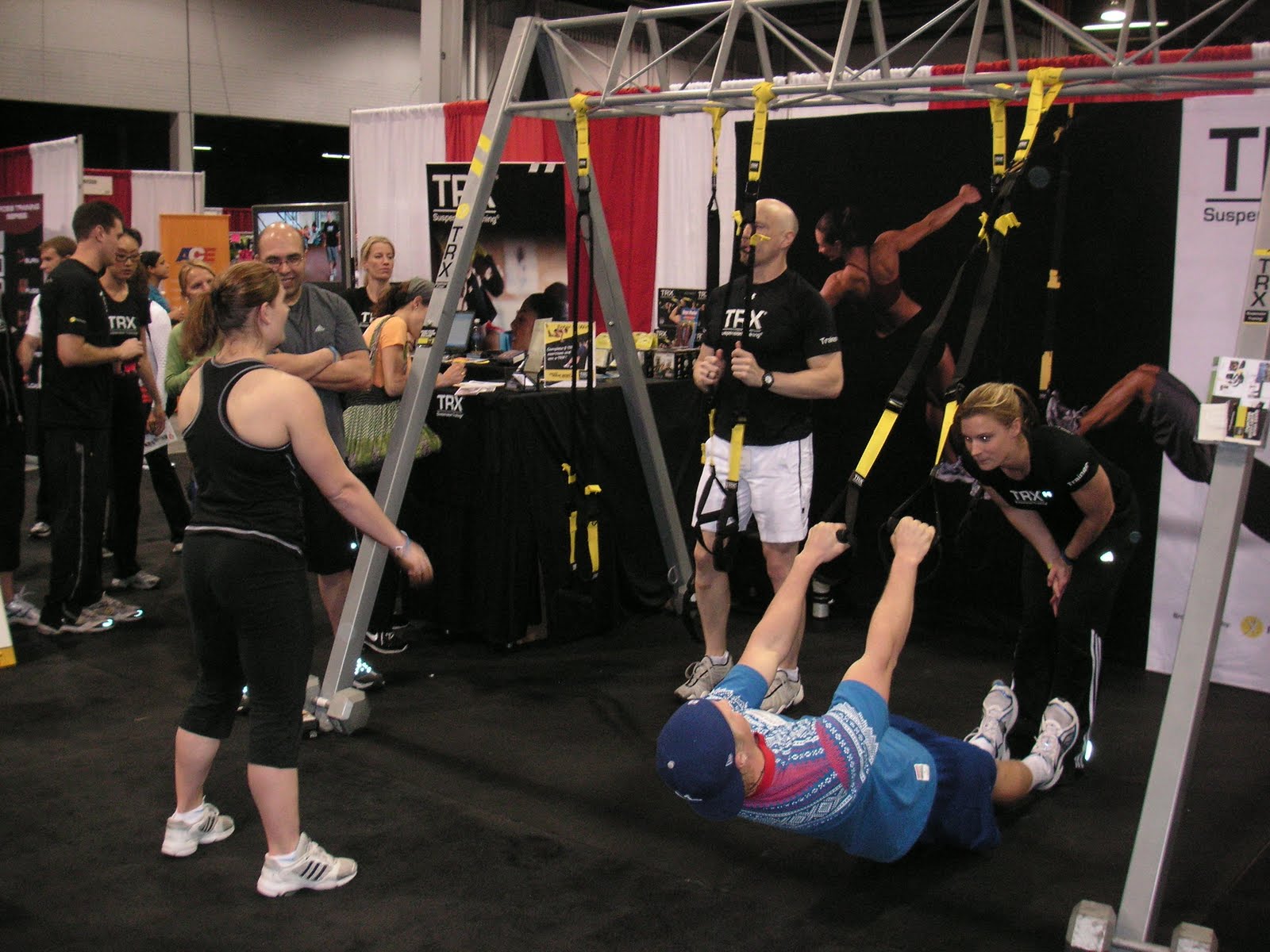
One of many trying (and failing) the 40/40 challenge at the TRX expo booth. I'm still biting my lower lip when writing this, falling short myself by only 4 reps (40/36...) to win a TRX (value $189)...I guess I could blame the failure on 3 hrs of workout sessions before, not enought sleep and dehydration - but I'm not going too=)
Function First Corrective Exercises was another presentation I attended that went along well with the previous one (MAT functional assessments). Anthony Carey, owner of Function First in San Diego (btw, another ideal place to live), also praised the MAT system but made a good point that it's not free to practice nation wide (US), using the certain techniques of the system – something I wouldn't have thought about. Overcompensations, muscle activation, posture analysis, improved biomechanics and simply how to make someone move better was brought up. Carey used a staircase leading up to a floating balloon as an analogy of how a client should be gradually progressed and assessed to reach their goals.
Lawrence Biscontini was the last presentation on Saturday – talking about how to promote yourself and stand out above the crowd in the fitness industry (hence the title of his book and the presentation; “Cream rises - excellence in private and group fitness education”). Lawrence had a lot of good and interesting tips to give but to be honest, he could've probably made chicken farming sound like my life calling – what a pro he was, extremely skilled in capturing the audience and his presentation technique was the best I've ever experienced. Very impressive.
Coming in to Sunday my head was pretty much stocked with information, luckily I took notes of everything thorough out the weekend. I listened to Tom Purvis' “Functional exercises: from bias to continuum”. He emphasized on what many others before him had touched on – exercises commonly thought of as isolation exercises is not the devil and that stereotypical functional exercises are often over glorified and has to have a purpose and good form – or else there's nothing good to it. Purvis, founder of Resistance Training Specialists, also talked about how certain exercises and movements might seem to produce a certain result but there's a difference between reality and what's being felt/perceived. “Exercises don't transfer so don't mimic a movement with added weight, thinking it will transfer to the desired sport/motion”. To clarify, this Youtube clip was shown that suddenly made every MLB pro (and trainer) seem stupid (at least according to that theory).
Jonathan Ross (Ace Personal Trainer of the year 2006) presented Personal Trainer v2.0 before wrapping up a busy, but very fun and inspiring, weekend in the windy city. Jonathan (Aion Fitness) delivered a stellar 2 hour presentation and it's incredible how useful it can be to listen to another Personal Trainer talk about what he does to be successful, his beliefs and philosophy. Educating people in health, make them less dependant and in that way more involved in fitness was some of the things highlighted.

Needless to say, I was more than satisfied after attending the IDEA 2010 Fitness Fusion Convention in Chicago, it was just the injection I needed (and a break from mainstream “food pyramid-static stretching-hola baloo”). I recommend anyone interested in fitness, enthusiast or professional, to attend such events as the time and money invested will pay back, with interest – guaranteed (although I highly recommend taking notes!).
Hopefully I will have time to post a summary of studies on Intermittent Fasting later this weekend so check back soon or look on the right hand side of this page and become a FOLLOWER!
Stay stong,
/Henrik
Subscribe to:
Posts (Atom)

 Posts
Posts


